Scalan News
Official Voice of the Scalan Association (SC022814)
Christmas Edition 2013, No 46.
Contents:
Page 2 - Important Dates from the Secretary
Page 2 - Points of Interest; Blairs Museum; Chapeltown Books - Sylvia Toovey
Page 4 - Three St. Ninian Chapels - Ann Dean
Page 6 - Golgotha Monastery Island, Papa Stronsay - Br. Jean Marie, F.SS.R.
Page 8 - Photos.
Page 14 - Priest Loggie, The Fiddler - Anne McWilliam
Page 16 - Homily at Annual Pilgrimage Mass given by Fr. James Thomson
Page 18 - Bishop Geddes’ Memoirs of the ‘45 (concluded) edited by Fr. Michael Briody.
Page 19 - Priests’ Pilgrimage to Scalan - “Peregrinus”
Page 20 - Summary of Annual Accounts 2012-13.
=================================================
Office Bearers of the Scalan Association:
President: Fr. James Thomson, St. Joseph’s, 73 Cardowan Road, Stepps, Glasgow, G33 6AA.
Treasurer/Secretary: Fr. Michael Briody, St. Michael’s, 133 Glenmanor Avenue, Moodiesburn, G69 0DL. Tel: 01236 872537.
Correspondence for the Association should be sent to the above address.
Minutes Secretary: Ann Dean, “Cairndale”, Provost Street, Huntly, AB54 8BB.
Editorial Team: Mrs. Sylvia Toovey, Ann Dean.
Correspondence regarding the newsletter should be sent to: Mrs. Sylvia
Toovey, Chapel House, Chapeltown of Glenlivet, Ballindalloch AB37 9JS.
e-mail: johnsylvia-braes@hotmail.co.uk; tel: 01807 590295.
=================================================
Important Dates
The Annual General Meeting is to take place on Tuesday 27 May 2014,
beginning with Mass at The Scalan at 12.30pm, followed by lunch in the
Braes Hall. The meeting proper is held thereafter.
The Annual Pilgrimage, with Mass at Scalan at 4.00pm, is held on the
first Sunday of July each year, which falls this coming year on 6 July
2014.
We always like to see new faces at both events, and so we are
announcing them well ahead of time so that you can put them in your
diary. In particular, the AGM needs an increase in attendance. A
healthy number present helps the exchange of ideas. We are not
complacent about the number who come to the annual Mass and are always
keen to see an increase there too.
=================================================
Points of Interest
The start of 2013 heralded heavy snowfalls but not the low temperatures
of 2012. The snow blew hither and thither piling up against buildings
(e.g. Scalan) and fences. Fortunately for the local farmers large parts
of the grass parks were blown clear which allowed the sheep to graze.
For a while we had free ranging sheep as they quickly worked out how to
negotiate the snow drifts against fences and gates. “The grass is
always greener” in the next field. Spring was at least three weeks late
which delayed the arrival of the lapwings, oyster catchers and curlews;
their numbers were down but the swallows returned in force and quickly
set up home in the Scalan buildings. We have no barn owls or hedgehogs
in the Braes but the roe deer have increased. September saw the arrival
of crossbills; a flock would arrive with their continuous chatter to
strip the seeds from the pine cones. At the time of writing, early
October, we haven’t seen the skeins of geese yet, passing through on
their way south.
After heavy snow Scalan College required new gutters in the front.
These have been replaced with good second hand cast iron ones painted
grey to blend with the existing ones.
The roof of the entrance porch to Sandy’s Cottage has been replaced
with “wriggly tin” (Braes style) and painted with black bitumen to
match the roof of the store room on the far end. Despite having heavy
duty wire netting over the two chimney pots the jackdaws managed to
hole it and enter the room; what a mess! The chimneys have now been
capped with stainless steel covers which will allow the peat fires to
be lit but keep the birds out. The cottage has been painted inside with
magnolia emulsion and the doors and skirting boards painted green. The
existing furniture has been washed and varnished and is in situ. Those
attending the annual Mass in July had a good look round and appeared to
approve of the layout and seeing the old cooking utensils. The
fireplace still has the sway and iron pots and is laid ready to light;
it doesn’t smoke but the peat gives off its own smell. Anyone wishing
to see the cottage is free to do so. They should phone John or Sylvia
Toovey beforehand for the key.
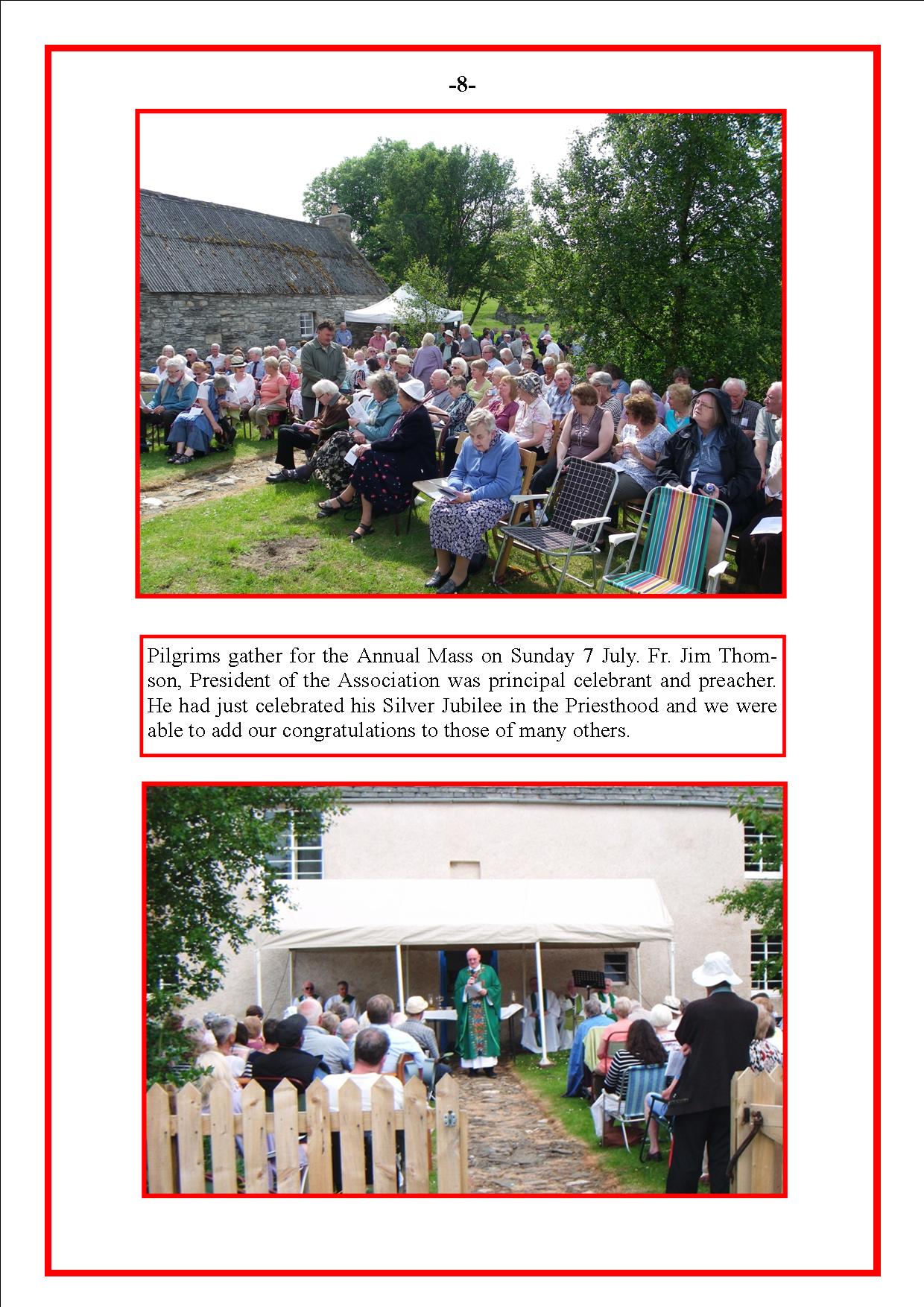
The annual Scalan Mass was attended by approximately 180 people but
fewer priests were present. The bagpipes echoes round the hills as he
played a welcome to the pilgrims. The Rev. Colin Stewart provided the
music for the Mass and Father Jim Thomson gave the homily which is in
this newsletter. The weather was perfect, dry and sunny with very few
midges. Jimmy Stuart was in good form on the bagpipes.
Now the cottage is finished John and I decided to supply tea, coffee
and home bakes, after the annual Mass, with a donation box. The
experiment was a success and will be repeated next year. Providing we
have prior notice we will willingly provide light snacks for those
groups visiting Scalan. If you are interested ring 01807590295 or email
johnsylvia-braes@hotmail.co.uk All profits will go to Scalan.
=================================================
Blairs Museum
Ian Forbes, the curator, has a large numbers of very interesting items
on display including a display case dedicated to Bishop George Hay who
was closely connected to Scalan. There is a chalice and other items. He
was an accomplished violin player and his violin has been restored by a
benefactor and now waits for an experienced player to bring forth the
music.
Another case displays items from the Braes of Glenlivet chapel. Abbé
Paul McPherson built a chapel for “the people of the Braes” in 1832 -
St. Mary’s. In 1897 Father McKenzie commissioned a larger more
elaborate building to accommodate the large congregation. It was
dedicated to Our Lady of Perpetual Succour. The chasuble he wore has
survived. The embroidery on the garment is exquisite and on the back is
a pelican. Why a pelican? She gives perpetual succour to her young from
her breast. There are a number of other items on display. There are
photographs in the chapel porch but they do not do the original items
justice.
================================================
Chapeltown Books
I have always wondered what happened to the books which, I had been
told, were rescued from the attics in the Chapel House. I found some in
the unused confessional in the house but apart from being damp, none
were old. Whilst talking to Pru King at Blairs Museum the question of
the Scalan and Glenlivet books arose. She found a publication called
“Dennis Doughty on Scalan and Glenlivet books” (one known copy in the
National Library) which described how the collection was “founded by
Abbé Paul McPherson. There were 550 books in the Chapeltown attics.
Around two ton of books, including some from Tombae, were sent to
Edinburgh for salvage during W.W.II. Bishop Maguire is reputed to have
rescued two sacks of the best from this lot. After research and
cleaning at St. Andrew’s University Library the books were distributed
to Aberdeen University, Pluscarden Priory and other places. Wherever
the books are I just hope they are appreciated.”
=================================================
Three St Ninian Chapels
Our north-east corner of Scotland had three post-Reformation Catholic
chapels dedicated to St. Ninian - in the Enzie, at Fetternear and at
Tynet. The first two are in ruins, and only St Ninian’s Chapel,
Tynet, is still a place of worship with Mass offered there regularly.
It is interesting to realise that St Ninian’s Tynet is a repository for objects which have come from the other two chapels.
The chapel in the Enzie was situated within St Ninian’s
Graveyard. The pre Reformation church, abandoned and ruinous, was
restored by the Rev J Irvin, under the protection of the Duke of Gordon
and the Catholics of the area used it from 1687 to 1725. There
are conflicting reports about this period; one report would have this
chapel destroyed in the early 1700s and later rebuilt by the Duke of
Gordon as a burial enclosure for his family, yet used by the Catholic
community. All reports agree about the year of the Raid in
1725. The Duke of Gordon was approached by a young Protestant
preacher, Mr Morrison, for permission to preach in St Ninian’s Chapel;
when the Duke refused, Morrison persisted and broke into the
building. He did so the next Sunday, when the Catholic community
rebelled and a riot followed. As a result the building was firmly
closed and consequently fell into a ruinous state although the burial
ground is still used. Mgr Sandy MacWilliam, one of the Scalan
Association’s founders, is buried there.
It is believed that the farmer of Chapelford, living close to St
Ninian’s, rescued several sacred vessels and altar ornaments which he
eventually gave to Mr Godsman, priest of St Ninian’s, Tynet. So
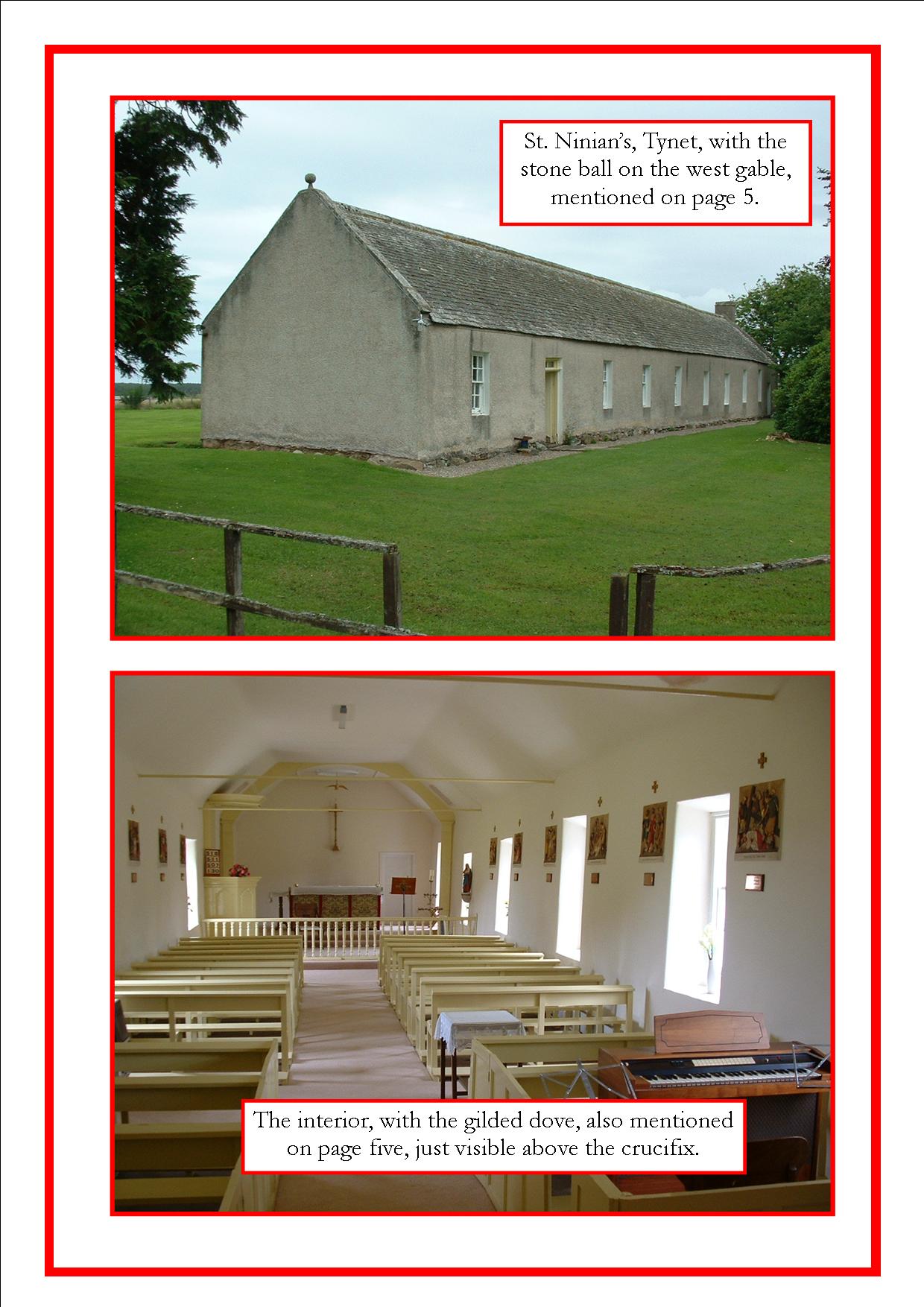
at St Ninian’s, you can see suspended above the altar attended by four
winged cherubs’ heads, a gilded dove which may have been used to
contain the Blessed Sacrament.
St Ninian’s Chapel, Fetternear was erected by James Leslie in 1848 on
the site of the pre-Reformation church, within its old graveyard.
As Fetternear is quite close to Aquhorties, where Bishop Hay died in
1811, he was buried at Fetternear within the ruins of the
pre-Reformation church, although the exact position of his grave was
never marked. The chapel was intended to be used by the Leslie
family and any Catholics in the neighbourhood, but with the building of
St John’s Fetternear in 1859, St Ninian’s became redundant as the
family had their own domestic chapel. The graveyard was still the
parish burial ground. The chapel itself was turned into an
impressive family mausoleum, enlarged by C.S. Leslie in 1878.
When Fetternear was abandoned by the Leslies after the mansion house
was destroyed by fire in 1919, St Ninian’s Chapel became ruinous; at
the sale of the estate in 1932, the church building was purchased by
Aberdeen Diocese because of its association with Bishop Hay.
Fr Grady, parish priest at St Ninian’s, Tynet, from 1948 to 51, when he
heard that altar furniture was lying around in the abandoned chapel,
removed two wooden Corinthian pillars and also Bishop Hay’s tabernacle
to be used as an olearium in the Baptistery at Tynet. In a note,
several years later, he wrote ‘last seen in the Tynet sacristy’.
In 1958, Fr. Grady, then in Torry, was asked by Bishop Walsh to oversee
the taking down and carting of the stone from the 1878 addition to the
Leslie mausoleum to complete the new church in Kincorth.
And the history of St Ninian’s Chapel, Tynet - recipient of articles
from the other two chapels? The Laird of Tynet enlarged an old
cottage into a sheepcote and presented it to the priest at
Auchenhalrig, Mr Godsman, in 1755. It was again enlarged in 1787
by Mr Mathison, with a stone ball placed on the west gable and the
chapel’s thatched roof replaced by the slates from the ruined St
Ninian’s in the Enzie. Today it still looks like a sheepcote as
the character of its exterior has been strictly kept, though the
interior was restored by Ian Lindsay in 1951.
So, in St Ninian’s Tynet, the memory of the other two chapels is kept alive.
=================================================
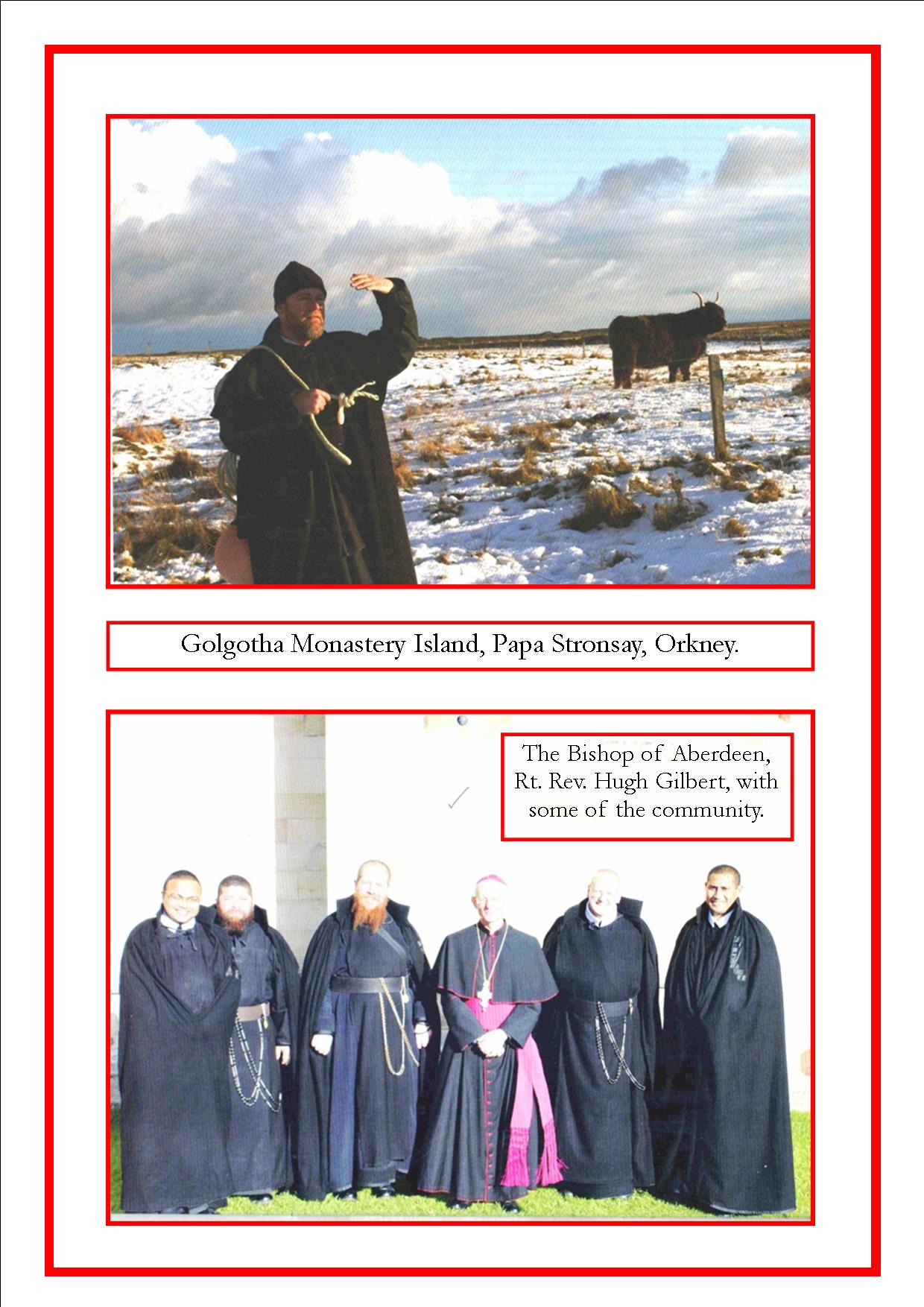
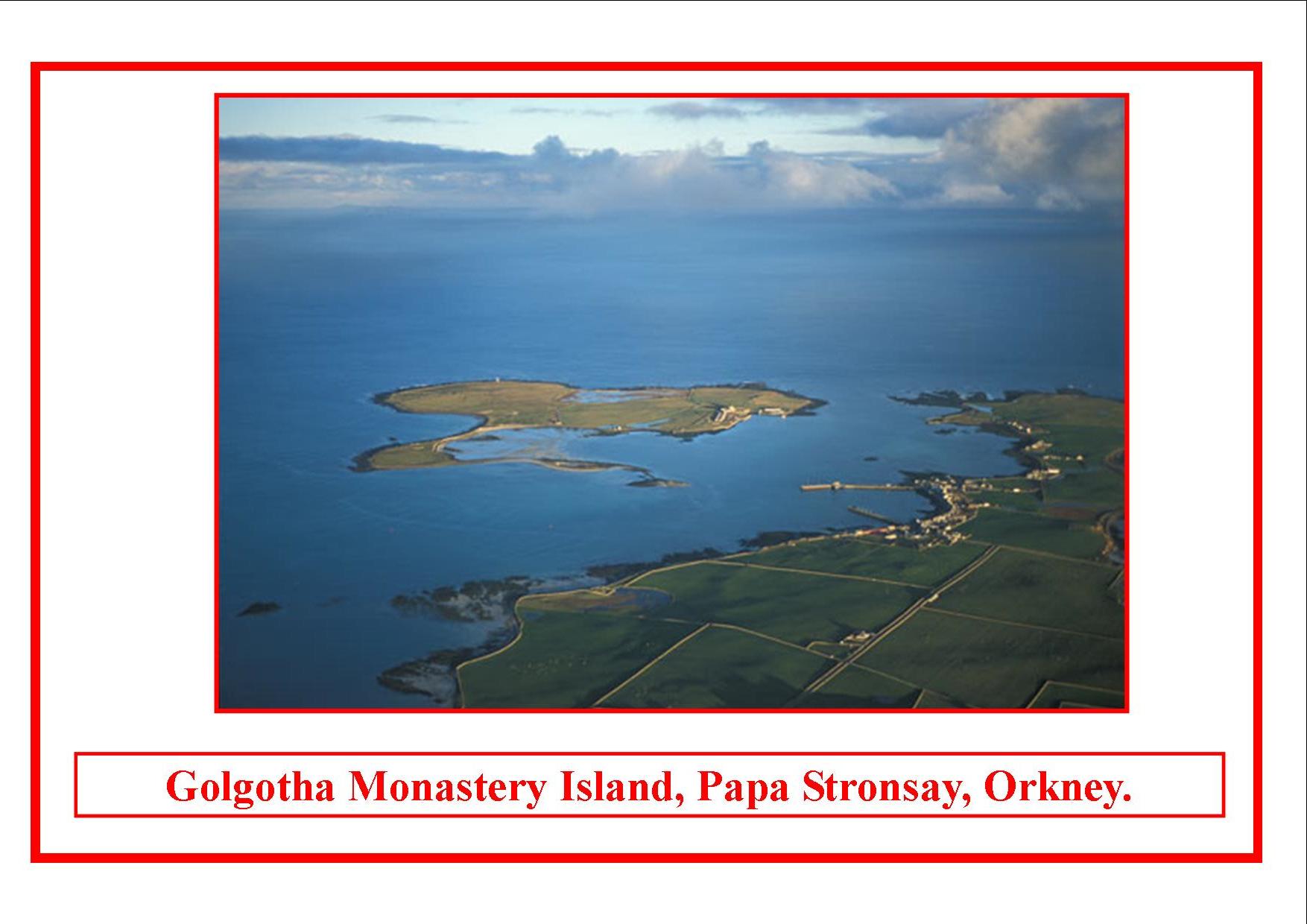
Golgotha Monastery Island, Papa Stronsay.
The reconciliation of our Monastic Community on Golgotha Monastery
Island, Papa Stronsay, with the Holy See in June 2008, in response to
Pope Benedict XVI’s motu proprio “Summorum Pontificum”, made
international news and was covered by numerous Catholic News agencies
both in print as well as on the internet. For many however, the main
point of interest was not our reconciliation with the Church, but that
we were a group of monks living in solitude on our own island in the
remote and windswept Orkney Archipelago and more or less cut off from
the rest of the world.
Living a life of prayer, solitude and silence on an island is not a
novelty. Indeed if the rocks, sand and soil on Papa Stronsay could give
utterance to speech, they would tell you that this is nothing new; that
they have been used to the tramp of monastic feet, chanted prayers in
Latin and the swish of habits for hundreds of years. For in truth
Papa Stronsay has been a monastic island since at least the sixth
century as the ruins of St Nicholas chapel on the island attest. Home
to the Papar monks sent forth by St Columba of Iona and lead by St
Cormac, Papa Stronsay has been a “Priest Island” for centuries; the
word ‘papa’ coming from the Norse word for priest.
Papa Stronsay is a tiny island, barely 200 acres at lowtide and is
little more than a flat grass covered rock that has dared to
raise its head above the tempestuous North Sea and stand firm against
the ferocious gale-force winds and the unrelenting waves that
batter its rocky shores all the year round; a fitting image of the
spiritual warfare that is the lot of every Christian soul. The monastic
cells, the austere climate, the near inaccessibility of the island, and
the stark beauty of the landscape have lead some to view the island as
some new ‘Alcatraz’ that has risen in the North Sea; but for us, as for
the monks of the last two millennia, Papa Stronsay has truly been the
“desert in the pathless sea”, the gateway and the waiting room to
Heaven.
The daily life of the monks begins at 4.55 a.m. with the ringing of the
monastery bell that invites all to arise from slumber and visit the
court of the Heavenly King. The day starts with the Angelic Salutation
and a blessing from the superior, followed by a half hour of mental
prayer on the eternal truths and an hour of the Divine Office during
which Matins and Lauds are chanted in Choir. This is followed by the
high point of the day, the daily Sacrifice of the Mass in Latin,
offered to God according to the 1962 missal, which is an essential part
of our lives and charism. Thanksgiving, breakfast and the recitation of
the Holy Rosary follow Mass. After this, the rest of the morning is
given to work. Meals are taken in silence after which there is an hour
of recreation. The afternoon is spent in the silence of the cell in
spiritual reading and other spiritual exercises. The community meets
again later on in the evening for an
other half hour of mental prayer and Vespers. Supper is followed by
another hour of recreation and the day ends with night prayers,
Compline and a blessing from the superior.
Living on an island means that we have to do everything ourselves and
within a short time any aspirant to our vocation picks up a multitude
of skills. These include driving tractors and boats, operating diggers,
block building, roofing, gardening, milking, butchering, cooking, as
well as a whole host of other activities which the daily maintenance of
the island requires. A lot of the manual work revolves around the farm
and the building and upkeep of the various structures that it
comprises. We have a small herd of Highland cattle, Jersey cows
and a flock of Gottland sheep that provide us with meat and milk
for the table. We also keep several breeds of chickens, ducks and
domestic geese that supply us with eggs and meat. A few fishing
trips, when the weather is good, ensure that there is enough of
mackerel and cod to last the community for a year. The large industrial
sized greenhouse, with which we have been blessed, provides us with
flowers for the altar all the year round as well as different types of
fruit including cherries, peaches, nectarines, grapes, and even kiwi
fruit! While there is plenty of manual work to go around, a lot of work
is done by some of the brothers on our publishing and internet
apostolate.
All this however is only one part of our lives. Besides the monastic
aspect of our vocation, there is also an active missionary side. The
Congregation of the Sons of the Most Holy Redeemer, or Transalpine
Redemptorists as we are called, can be best described as missionary
monks. Our vocation is to be “Carthusians at home and Apostles abroad”.
The missionary part of our vocation essentially consists in preaching
parish missions and hearing confessions. For the time being however,
given the small size of our institute, (we were only erected as a
clerical institute by the Bishop of Aberdeen in August 2012), our
missionary apostolate is confined for the most part to our new daughter
house in the diocese of Christchurch, New Zealand. Our community
has taken over the Latin Mass Chaplaincy in Christchurch and provides
the faithful with Mass and the sacraments in some of the parishes of
the diocese.
Our close-knit community is truly international, being composed of
members from all over the world including many young vocations in their
twenties and thirties. It is a sign that the attraction of monastic
life is as strong as it was in centuries past when the deserts of Egypt
and Palestine were peopled with hermits and anchorites who sought to
leave the world and save their immortal souls. This great thought of
Eternity, the importance of the salvation of one’s immortal soul,
and the deceit and empty
ness of worldly pleasures continue to draw souls to religious life even
today. Many a young man like St Augustine has realized that our hearts
are restless until they rest in God; that He alone is capable of
satisfying them. The world does not understand why anyone would want to
be a monk, but ask any monk and he will tell you that he has already
received of the hundredfold that Our Lord has promised for those who
hear his voice and leave all things and follow Him. [Mt, xix:29]
Br. Jean Marie, F.SS.R.
Golgotha Monastery Island,
Papa Stronsay,
Stronsay, Orkney
KW17 2AR
Website: Papastronsay.blogspot.com
Email : contact@the-sons.org
=================================================
Priest Loggie, the Fiddler
Many years ago, my christening was at St Ninian’s Tynet – the lovely,
simple old chapel (written about on page four) where the walls hold
centuries of prayer. My mother was christened there, her mother
before her in 1868, and possibly her mother before that, but of this I
am not sure.
Some of the old Chapel’s history has been written down and it is
fascinating to glean how personality can affect events. We can
read of Mr Godsman the then priest at Tynet who was clapped into prison
in Fochabers in the dreadful aftermath of the battle of Culloden.
He was released after a few days because the folk in the area
protested, claiming that he went around garbed as any farmer, quietly
going about the business of caring for his flock.
Years ago I came across ‘The Fiddler’, one of the poems penned by J. M.
Caie, M.A, B.L., B.Sc., a lecturer in Agriculture before joining the
Board of Agriculture. He grew up in the Manse at the Portgordon
crossroads and wrote many poems about the Enzie and its folk.
Would these lines of the first verse of ‘The Fiddler’ not make one wish
for more information?
Some say ‘twas Priest Logie first learnt him the knack,
An’ nae muckle winner,
For files fin ye h’ard him ye’d sweer he could mak’
A saint o’ a sinner.
I wondered much about Priest Loggie and some years later was sorting
through an old box with newspaper clippings, a 1822 coin very roughly
soldered into a brooch, etc. – and found a little more about Priest
Loggie from his Obituary. He died on the 29th May, 1885, aged 64,
in the 40th year of his priesthood:
“Death of the Rev. Wm. Loggie, R.C.C., Tynet. – Tidings of the death of
this estimable gentleman, which occurred at Tynet on Friday morning,
after a week’s illness, were received with general sorrow and
regret. …During his residence at Tynet [25 years] Mr Loggie had
made many friends, and was held in much respect …not only was he very
popular among the members of his own congregation but also among those
of the other denominations in the district who always found in him a
most obliging neighbour. … Mr Loggie possessed excellent
abilities, but was in manner quiet and unassuming. He found his
great recreation in music, and he not only knew the science in theory,
but as a master of the violin he was known to have few equals. He
was the possessor of a very old and much prized instrument, and many
young men in the district, who are now good performers, were indebted
to Mr Loggie for their training. He generally had a class of
young men, whom he taught without fee or reward…”
A friend helping me said ‘Isn’t that very queer not charging for the
lessons?’ I said ‘folk did not think about money so much in those
days. Local loons would have just dug over older folks’ vegetable
patches, being neighbourly, and their mothers would have put a share of
their baking into the housekeeper at the Chapel House - that sort of
thing was the way folk lived’.
So it is fine to think of Mr Loggie settled at Tynet for his final 25
years. The Poet would have been seven when the Priest died, but
Mr Loggie could have known his Minister father and family well.
Below are some more verses from ‘The Fiddler’:
For young an’ for aul’, for blithe an’ for dour,
For dancers an’ singers,
For a’ that had lugs, there was magical poo’r
In’s bow an’ in’s fingers.
But noo he’s awa’, an’ his meesic nae mair
Comes lauchin’ or sabbin’.
Tae hiz onywye – although maybe up there,
As seen’s they loot Rab in, ……
The Almichty wad say tae the angels a’ roon’
His deece i’ the middle,
‘Jist heely a meenit; your harps lay ye doon;
Rab, hae ye your fiddle?’
Such a COMFORTING picture of a homely HEREAFTER. While writing
this for the Scalan Newsletter, the thought came to me – I wonder what
Canon Sandy would have thought of the poet’s vision of the ‘hereafter’?
=================================================
Homily at the Annual Scalan Mass, Sunday 7 July 2013, (delivered by our President, Father James Thomson).
Once again I thank you all for the efforts you have made to get here.
It is truly a “pilgrimage” - the journey to Scalan. Its remoteness was
one of the attractions of Scalan in Penal Times as this allowed the
seminary to function with occasional upheaval when the soldiers would
get to this area.
The Scalan Association invited people to make this pilgrimage today to
pray for priests - priests who are serving in Scotland at the moment
and for vocations to the priesthood.
At a speech given to the Guildhall in London on 24th November 1992,
Queen Elizabeth II described that year as an “Annus Horribilis”. With
the breakdown of three of her children’s marriages and the devastating
fire at Windsor Castle, we can understand why she called it a “horrible
year”.
For the Catholic Church in Scotland, 2013 is an “Annus Horribilis”.
With the scandals about the Cardinal, various priests and the
publication of an on-line book, we can certainly echo the sentiments of
the Queen.
We have all been hurt by it. Maybe in different ways, but we all are
hurt. At times I dread checking the papers or the news, in case there
is going to be some further story. I must confess that I don’t buy a
paper, well apart from being too tight - I won’t give them the money -
but I do check them on-line. At times my heart sinks when I read the
next part of a story, or a regurgitation of a story, or a new story -
it hurts.
I have no mandate to speak for anyone else but myself, but I would like
to say sorry to you for the hurt caused by priests through our
failings. I have my own failings and my poor parishioners have to
suffer them, but they are not really newsworthy. Some failings do hit
the headlines and people feel disappointed, let down, betrayed. For all
our failings I ask your forgiveness.
I realise that you may have to suffer in a different way - the comments
from work colleagues, neighbours,or even friends, about the Church you
hold so dear. It may even shake your faith, but what we must remember
is that we do not put our faith in any cardinal, bishop, priest, not
even in a pope - we put our faith in Jesus Christ - he is our “Spes
Unica” - our only hope But again I say sorry to you for the hurt
caused, but please don’t give up, remain strong, remain faithful to
Jesus Christ.
The Gospel at today's Mass is the ordinary Gospel for this 14th Sunday
of the Year. Quite by chance it is the story of Jesus sending out 72
disciples to spread the Good News. “The harvest is rich, but the
labourers are few, so ask the Lord of the harvest to send labourers to
his harvest”. We gather today with that intention very much in our
prayers. We pray that those the Lord is calling will be able to hear
that call. The problem we have today is not that the Lord is no longer
calling men to priesthood, He is, it is that there is so much noise and
distraction in modern society and living, that the voice of the Lord
cannot be heard. We pray today the those whom the Lord calls will hear
His voice and have the courage to respond to that call. We need to pray
every day for this intention. As we know only too well, the image of
the priesthood has taken a dreadful battering, and you wonder why
anyone would want to become a priest.
But we have got to ask ourselves what practical thing can I do to
encourage any eligible man to think about the priesthood. First, we
must be positive about our Church and about priesthood. We need to
combat the negativity that is out there, especially in the press. Read
the papers and listen to the news critically, don’t believe all you
read or hear. Ask questions about what is said with regard to the
Church or priests. The internet is a great thing, but it can carry all
sorts of stories, not all of them true. Sometimes people put forward
gossip as truth. Unfortunately some of the stories will be true, and
again I apologise for that. But not all of the stories will be true and
that is why we must ask questions before we accept what the papers say.
We can rejoice in four new priests for Scotland ordained in the past
week or so, two for St Andrews and Edinburgh, and one each for Glasgow
and Argyll and the Isles. We give thanks to God for them, but it is not
enough. We need to pray that others will respond to the Lord’s call,
and we need to encourage them by putting across the positive aspects of
priesthood and there are many, many positive aspects to priesthood, not
least the support given to us priests by the people we serve.
A recent study by the psychologist, Monsignor Stephen Rossetti entitled
“Why Priests Are Happy: A Study of the Psychological and Spiritual
Health of Priests” tells us that the vast majority of priests are happy
in their priesthood.A survey in America showed that 92 percent say they
are happy in their ministry, among the highest rate of satisfaction of
any profession in the United States.
Six priests recently celebrated their Silver Jubilee. I was at four of
these celebrations, and the word celebration is indeed apt, because all
of them were joyful occasions. It was great to see these men happy in
their work, in their priesthood, even after 25 years and despite all
that has been happening recently. At the celebrations I attended, the
priests involved asked the congregation to focus, not so much on the
individual priest, but on priesthood in general; and they asked for
prayers for priests.
Jesus sent out the 72 disciples to carry the Good News to the people
they met. I would like to send you away today carrying the good news,
the positive news of the priesthood. There is much to celebrate and be
positive about in the priesthood. Pray for us and pray for vocations to
the priesthood.
=================================================
Memoirs of the 1745 Jacobite Uprising and its aftermath - concluding
part.(written up in later life by Bishop John Geddes - he was ten years
old in 1745):
“During this persecution, rumours were spread that all the Scottish
Catholics were to be banished to America ; and it was confidently said
in the beginning that the goods of all who should not go to the Kirk
would be confiscated. However, I did not hear of one in the Enzie who
abandoned the Catholic religion. Two or three indeed went once or twice
to the Kirk ; but they very soon repented, and returned to their duty.
On the contrary, great fervour appeared among the Catholics, with great
love to one another, and they seemed to be happy at being reduced to a
state something like the first Christians. To their having these good
dispositions, the example and exhortations of Mr Godsman greatly
contributed; and I was witness of his receiving into the Church several
persons in the winter immediately after the Battle of Culloden.
“In Glenlivet, Strathaven, Braemar, the Western Highlands, and the Isle
of Uist, the exercise of the Catholic religion was more disturbed by
frequent searches made by the troops for the Missionaries. On this
occasion, Mr William Harrison distinguished himself by his courage and
zeal. He presented himself to the Sheriff of Argyllshire, told him
frankly that he was a Catholic Priest, but had neither done nor meant
harm to anybody, and begged protection. The Sheriff was well pleased
with his confidence, and gave him a paper signed by himself, requiring
of everybody to allow him to go about his lawful business unmolested.
In consequence of this, Mr. Harrison, in the summers of 1746 and 1747,
visited almost all the Catholics in the Highlands, administering the
Sacraments and exhorting the people to patience and perseverance in the
faith. The Missionaries continued to be much harassed, and kept in
almost constant alarms in many parts of the Highlands, for more than
ten years, until the war broke out in 1757 (the “Seven Years War” which
broke out in 1756), and then the parties that had been stationed
through that country were called off to be sent abroad to the army.”
=================================================
Priests’ Pilgrimage to Scalan
In the difficult times we have had this year it was thought to be a
worthwhile idea to provide an opportunity for priests to “come away to
a lonely place and be by themselves for a while” as Our Lord provided
for his Apostles at a particularly fraught time. Priests throughout
Scotland were invited through their respective diocesan offices and
encouraged to make the effort to go on pilgrimage to Scalan, with all
the strong priestly connections it has, to meet, to talk, to celebrate
Mass, to have a meal together, to renew some of our energy, our ideals
and our Faith.
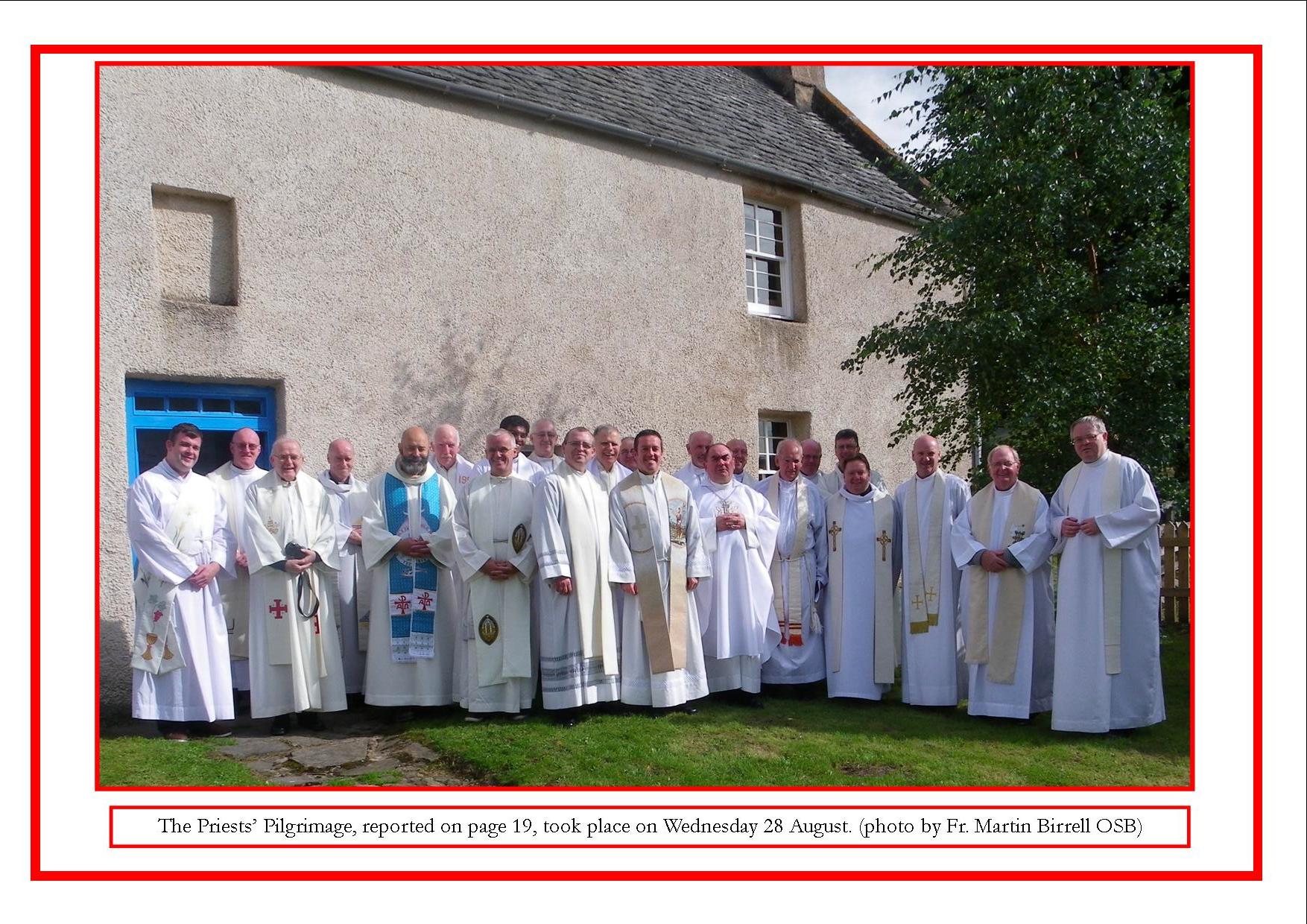
Twenty three priests and a deacon responded to the invitation and came
from all parts of Scotland to concelebrate Mass with Bishop Toal who
gave us a message of re-assurance while challenging us at the same time
to make a serious renewal of our priestly service to God and God’s
People. He spoke of human frailty and God’s mercy and the forgiveness
which we should practice also. He held up the example of St. Columba
who made grave mistakes but made a new beginning by leaving his native
Donegal and bringing the Faith to the Highlands and Islands of
Scotland. St. Augustine too, whose feast it was, converted from an
early dissolute life to become an outstanding teacher of the Faith
whose influence is still strong today. Lastly he considered the boys
and young men who left home to live at the remote location of Scalan to
prepare for the Priesthood in very difficult times. They had their
faults and failings but they committed themselves to serve as priests
for the rest of their lives in our country at a crucial time for the
revival of the Catholic Church in Scotland.
After Mass, the group had a meal in the St. Michael Centre, Tomintoul,
before heading for home. It is hoped to repeat the pilgrimage this
coming year.
=================================================
A Very Happy Christmas Season to all our Readers.
Photographs
Golgotha Monastery Island, Papa Stronsay, Orkney.
Pilgrims gather for the Annual Mass on Sunday 7 July. Fr. Jim Thomson,
President of the Association was principal celebrant and preacher. He
had just celebrated his Silver Jubilee in the Priesthood and we were
able to add our congratulations to those of many others.
The Bishop of Aberdeen, Rt. Rev. Hugh Gilbert, with some of the community.
Golgotha Monastery Island, Papa Stronsay, Orkney.
St. Ninian’s, Tynet, with the stone ball on the west gable, mentioned on page 5.
The interior, with the gilded dove, also mentioned on page five, just visible above the crucifix.
The Priests’ Pilgrimage, reported on page 19, took place on Wednesday 28 August. (photo by Fr. Martin Birrell OSB)