James Sharp
James was the last master appointed at Scalan, 1792-1799. He was born in 1768 at Mortlach. His brother, John, was born in 1772 and acted as assistant master from 1796-1799.
Students James Sharp, Johnny McDonald and Ronald McDonald left the college at Scalan some time in July 1782 and made their way on foot to Edinburgh. They sailed from Leith to Ostend in Belgium, a journey that took eleven days due to unprecedented storms. Owing to the gale force winds they left the boat on the coast of Flanders and waded ashore. Wet and bedraggled they reached Douai where the former Scalan master, John Thomson, met them. After resting for a few days he escorted them overland to Leghorn then by sea to Rome. John Thomson entered the Scots College, Rome in 1759 and was ordained there but did not speak favourably of the place under the Italian Rector. He spent ten years in Rome but was always regarded as an outsider although he was the Scots agent in Rome. It was he who looked after the welfare of the Scottish students. James Sharp was ordained in 1793 and returned to Edinburgh. He was appointed master at Scalan in November 1793; his brother was appointed assistant master in 1796. Both positions remained until its closure in 1799.
Change was already in the wind. The Scots Colleges at Paris and Douai were closed and the future of the Rome seminary was uncertain. The increase in the numbers of students wishing to train for the priesthood meant that Scalan was unable to cope. Bishop Hay realised a new seminary was needed: one that could handle students from year one to their ordination. Students who went were required to help with a farm and didn’t need to know about whisky distilling and the said product passing the door.
The Sharp brothers were having problems with their students. Neither was experienced enough in handling boys who weren’t all dedicated to studying and didn’t respond to the strict discipline. One boy was frequently reprimanded for dallying with the maid and had to be told to leave. Bishop Hay was well aware of the Scalan problems and was looking out for new premises. One was found at Oxhill in the Enzie but the price was too high. In 1795 the Bishops asked for re-imbursement for the two colleges closed abroad. Success! Money was now available for the new Scalan which would be sited at Aquhorties near Inverurie. The estate belonged to John Leslie of Balquhain, a Catholic and a good friend of Bishop Hay. After extensive negotiations the estate of 600 acres was acquired on a ninety nine year lease. By 15th of July Aquhorties was ready to receive its first party of students from Scalan. Priests John Gordon, Alexander Badenoch and George Gordon had been busy getting the house ready since the beginning of the year. Bishop Hay, Willie Sloan and John Sharp plus two maid servants arrived the following week. A building grant from the government was yet to come. Quote from Bishop Hay ‘O how wonderful are the workings of divine providence. Twenty year ago they were burning chapels and houses and, now they are helping to build chapels and colleges.’
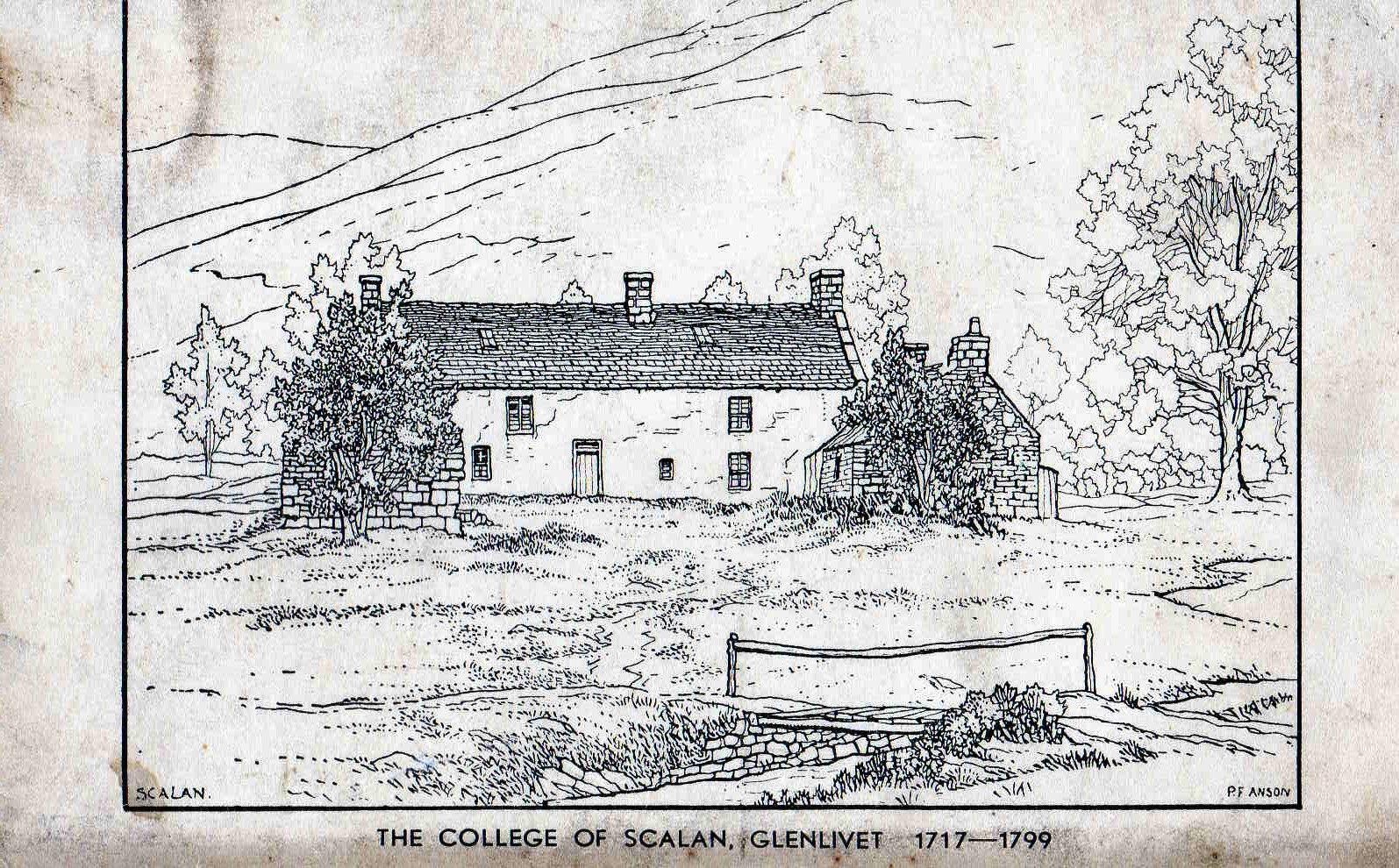
1799 was farewell Scalan Seminary; if only bricks and mortar could speak. You sheltered those wishing to follow their own beliefs. Today you stand alone; the Crombie burn flowing past your door. The landscape undergoes seasonal changes but the ruined crofts can still be seen. Summer is when Scalan comes into its own. Visitors walk to see the solitary building; to enter its doors and see the original flagged floors, rough stone walls and exposed beams is to enter the past. The feeling of peace is locked into The Scalan. Children talk of ghosts; if there are any they are of tranquillity.
Scalan remains open in the winter when hardy walkers and skiers are grateful for its shelter from relentless wind and snow. The seminary is there for all to visit. If you are disabled you can drive up and there is access to the ground floor. Sit outside and enjoy the peace and quiet or wander off to explore.
Sylvia Toovey
Still in the past but moving on
When Scalan closed in 1799, the pupils and staff were moved to Aquhorties near Inverurie with larger premises and better facilities. This was to be ‘the new Scalan’. After thirty years the seminary was relocated to Blairs where it stayed until its closure in 1986
James Sharp, the last master at Scalan, stayed on to run the farm and serve the local people. Mass was held in the down stairs Chapel weather permitting.
Bishop Cameron transferred the Scalan lease into James Sharp’s name and when new tacks became available he had sufficient funds to purchase them, acquiring the tacks for Easter Scalan, Fuarandearg and Eskemullach. Sharp became the tacksman; tenant farmers paying their rent to him and he paid a portion to the Duke of Gordon’s estate. In 1807 Sharp was told to join the staff at Aquhorties where he was made Procurator, a post he held until 1826.
On July 10th 1807 James Sharp had a sale of his effects and moved out with a heavy heart. Over the years he had grown to love the area and enjoyed the company of the local people. Miss Helen Cameron, the Bishops sister, moved into the big house and the land was sublet to John Stuart of Balevlair. She was supported by her brother financially and with food parcels: The Bishop was her only benefactor, The Tombae priest, Alexander Patterson, was her only visitor. He dropped in when checking his cattle and horses grazing the fields nearby.
She rattled around in the big old house feeling isolated and abandoned, never came to terms with life in the Braes, dying a lonely death in 1832.
In 1823 the tacks came up for review and the church decided to give up much of its land only holding on to the park and land on the east side of the Crombie plus the adjacent weaver’s croft. The land was distributed to the local tenant farmers. A new tack was on offer, the Faevait, one and a quarter miles down the Braes. This was offered to Abbé Paul McPherson when he returned from Rome to keep his promise‘to build a chapel for his people of the Braes’. With James Sharp leaving Scalan the Braes Catholics had to travel to Tombae for Mass. This meant fording the River Livet, not much fun in winter when the ladies had to hitch up their long serge skirts and probably would have had cold wet feet to content with.
The Duke of Gordon gave the tack to Abbé Paul and in 1832 the church was finished within two years. There is a sketch of this building but no plans. Two years later a school for boys and girls was completed; all funded by Abbé Paul. The first headmaster was Mr. Farquharson who is buried in the graveyard.
The new church covered the Mission’s needs and it lost interest in Scalan. After Miss Cameron’s death the big house was inhabited by local farmers and it slowly deteriorated. It wasn’t until the end of the Second World War when various priests and lay people started questioning the future of the building which had played such an important part in the religious history of Scotland. Scalan was to be restored and opened to visitors at all times. If a group of people have a priest with them Mass can be held in the upstairs chapel or the much larger dormitory. Weather permitting outside where the ruined chapel wall can act as an altar. The highlight of the Scalan year is the annual Mass held on the first Sunday in July at 4 p.m. All are welcome including well behaved dogs.
Scalan is secure for now and in the future looked after by members of the Scalan Association but what of Tombae and Chapeltown churches built four miles apart by road? Both built when the penal laws were easing and people felt easy about attending Mass. Chapeltown was rebuilt in 1897 by Father Colin Mackenzie who needed a larger and more imposing building to accommodate the local Catholic population. Mass was held at least three times on Sundays and during the week. Today in 2012 both churches are shut for three months in winter and Mass is held only every third week in summer. They are always available for funerals and weddings. The churches are usually half empty and so are the communities. Neither has a shop or a school, Chapeltown’s shop closed in 1984 and the school closed in 1964. Will the two churches eventually close through lack of a priest and too few parishioners or will people begin to realise that religion should and could play an important part in everyday life.
Census figures for the Braes
1814 1822 1841 1851 1861 1871 1881 1891 1901 1911 2011
624 425 511 559 588 540 521 449 376 306 69
1814 1822 1841 1851 1861 1871 1881 1891 1901 1911 2011
624 425 511 559 588 540 521 449 376 306 69
Since writing this article Tombae Chapel has closed and the Braes of Glenlivet will hold Mass fortnightly from and including Easter Sunday at 9.30 am until late December.
Sylvia Toovey
Balgowan or Blairs
Within the ruined church at Peterkirk near Huntly, there is an impressive table tombstone with the inscription still fairly clear: In memory of Mrs H Gordon, spouse of C Grant of Balgowan who died 21st November 1817 aged 67. Their son Robert Charles Grant, who died on the 23rd March 1823 in his 35th year, is also buried there but no inscription was added to the tombstone.
It is with Robert Grant that this article deals, but before revealing the connection between Robert Grant, Balgowan in the parish of Keig and Blairs, four miles from Aberdeen, a short history of the family might be helpful. Henrietta Gordon of the Mill of Smithston Gordons along with her sister Jean, unexpectedly inherited the small estate of Balgowan in 1785 from their uncle John Gordon, their brother Charles having died in Granada before the death of his uncle. Balgowan had been purchased in 1690 by Adam Gordon, Henrietta’s grandfather. Jean gave her share of the estate to her sister, who then gave Balgowan to Charles Grant in Blairfindy to whom she was married in 1786 by the parish minister of Rhynie. Before the marriage, both of them ‘took the formula’ before the Presbytery by nominally renouncing their religion, thus making secure their possession of Balgowan.
Robert Grant was baptised by the parish minister of Keig in 1786. The family appear to have lived mainly in Aberdeen, Robert Grant attending Marischal College and in 1811 he became an advocate. His father Charles Grant was fined and imprisoned for four months for being an accessory to fraud and forgery. To avoid the danger of possibly forfeiting Balgowan to the Crown, he handed over the estate in 1813 to his son Robert.
Henrietta Gordon died in 1817, and in 1823 Robert Grant also died. He made a will before his death; his father is given a regular income from Balgowan during his lifetime. However the whole estate he made out in favour of the then bishop in charge of the Lowland District of Scotland all and whole the lands and Estate of Balgowan, for the purpose of enabling the Disponed above named, to erect, establish and continue in all time coming a college in Scotland similar to the one at Aquhorthies – when its lease expired, to remove it to Balgowan. With certain other funds and the residue of his estate allowed to accumulate, and with the rents from Balgowan, there would also be sufficient funds to build a school for Catholic children within or near Aberdeen.
Robert Grant’s wish that a school be provided for poor Catholic children was finally realised in 1833 with the opening in Constitution Street of the first Catholic school in Aberdeen since the Reformation. And in 1829 the College at Aquhorties moved to Blairs. Robert Grant had left Balgowan as a suitable place for the ‘new Aquhorties’ but Menzies of Pitfodel’s offer proved to be more attractive. The Balgowan Trust was used to enlarge Blairs in the early 1900s. After its closure in 1986, the Trust now provides a First Trust for the training of priests in Scotland and a Second Trust for the Schools in Aberdeen.
Ann Dean
Points of Interest
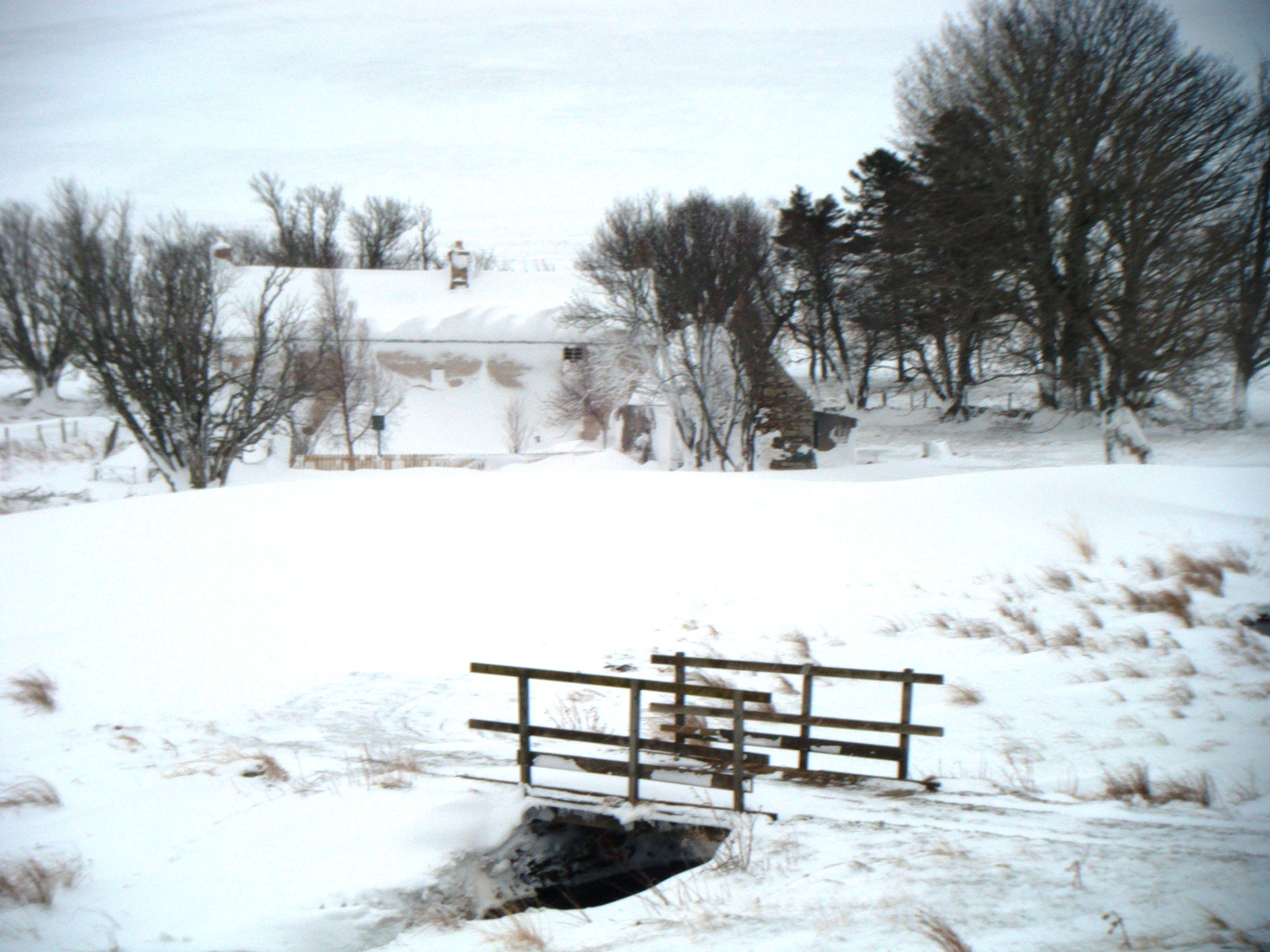
1. Scalan has not had any visitors since December 2012 mainly due to the weather which has ranged from wet and miserable to freezing cold with a wind from the artic bringing snow in February which ¾ covered the entrance. It had shrunk to a height of 2ft but on the 24th March the snow, which had collected on the Ladder Hills, was blown off by a strong east to south east wind and dumped on the Braes road and surrounding area. The road was soon cleared but the track to Scalan was full. Two days after spring arrived my husband plus dog walked to Scalan. Leaving Chapel House was easy but the track to Scalan was deep snow on an ice base. The easier way was to step over the fence into the field where the wind had blown the snow onto the fences. He made the main gate into Scalan and onto the bridge to be met by a snow drift stretching between the two barns and covering the mill lade to a depth of about 8ft. The only parts of Scalan visible were the roof, chimney pots and bits of upstairs windows. The ruined chapel was inaccessible but Sandy’s cottage gable end was clear. The Seminary is sleeping beneath a blanket of snow. I’m sure it has happened before; it is well built with stone walls and a slate roof. It was built to survive; not like the other houses which were built with stone and sod walls, beaten earth floors and sod or heather thatch roofs.
The majority of the 18th century houses at Scalan were erected by those living in the community, money was short and they were looking for a roof over their heads. The peat fire would be in the middle of the room with a hole in the roof to let the smoke escape. Peat was dug in May from the peat moss, there being very little wood and no coal available. The family would have been involved on extracting the peat, stacking it to dry and in late summer carting it home. The animals were housed in a byre in the gable end of the house with access to the house. They helped to keep the room warm and it made milking and feeding easier.
Some hovels would have a well but many would collect their water from the burns where the animals drank. Health and hygiene was not an issue, so no wonder their life spans could be cut short by illness.
There were many disadvantages to living in the 18th century. It was a hard life at Scalan but little better in the towns. To us with our modern facilities, homes, roads etc., to go back in time would be impossible but there was one advantage. No matter where you lived there would be family ties and a strong community spirit. People pulled together and helped each other; this seems to be lacking in so many areas throughout the country. People appear to be wary of each other and would prefer to walk away and not offer a hand of friendship.
At the time of going to the printers, 5th April, the door is still covered by snow!
2. Despite the freezing nights and cold winds the 3rd April saw the arrival of the oyster catchers. The lapwings and curlews also returned after arriving two weeks earlier, but finding the conditions not to their liking, had gone down country again.
The Lass of the Lecht
Ye Cromdale people both young and old,
Pray hear the tale I now unfold,
It will make your blood run cold,
To think upon that morning.
A blooming lass in her eighteenth year
Across the Lecht her course did steer.
The way was rough and wild and drear
Upon that winter morning.
Soon the storm came down with fearful force,
It beat her sore with no remorse,
And in the blinding drift she lost her course,
On Earnan’s hills that morning.
Beyond the reach of human cry,
No earthy help nor shelter nigh,
She fell exhausted down to die,
By Earnan’s banks that morning.
Her master soon did anxious grow,
He raised the country high and low,
And to the hills at once we go,
Five hundred men next morning.
Hardy lads from Corgarff, Stra’down,
Fair Avon sides and eke Glenbrown
Upon the Lecht assembled round,
To seek for the corpse that morning.
Glenlivet and Glenconglass, too,
Turned out in numbers not a few,
To search the mountain passes through,
Her corpse to find that morning.
Chapeltown lads did not neglect,
Through drift and snow to face the Lecht,
And each and all won great respect.
The Tomintoul men deserve great praise,
They bravely toiled the lost to trace,
And sorrowing friends for many days,
Will recount their deeds that morning.
The Reverend Glennie, a priest of fame—
God bless for aye his honoured name—
Refused to rest or stay at hame,
But sped to the hills that morning.
Farquhar of Invercauld, I trow,
And Forbes the honoured laird of Newe,
Did bid and board to all bestow
Who sort her corpse that morning.
Afar and near the searchers went,
With two blood hounds from Invercauld sent,
But all in vain, though keen of scent,
They failed in their quest that morning.
From each hillside the smile of May,
Had chased the winter snow away,
When there exposed the body lay
Bt Earnan’s stream one morning.
A shepherd lad did find the dead,
And many a tear of sorrow shed,
While his heedless flock around him fed,
On Earnan’s banks that morning.
The body soon was thence conveyed,
By all respect was to it paid,
And in Corgarff Churchyard was laid,
Till the Resurrection morning.
In the search for the corpse that morning.
Scalan.co.uk; a progress report.
In the years that I have run the Scalan web site I have always been aware that it is a second best option in the communication of the Scalan News and it is with great pleasure that I report that all editions of the Scalan News are now online and available for research or browsing.
In reading each edition I noted how a small news sheet became a fully fledged historical resource illustrated with the drawings of Ann Dean and the ironic comments of Alasdair Roberts. Today Scalan News edited by Sylvia Toovey has colour
I was interested to read that Peter Anson had commented that it was a shame that Scalan was in such a state in the early days from an early edition and I feel that he played a part in the formation of The Scalan Association with so many others.
I am currently trying to obtain a catalogue of all his paintings and drawings especially of a religious nature through liason with Moray Council, Stan Bruce, Columba House and others. I feel that this would be a major resource and any information you have will be directed towards the appropriate person. E.g. There are some paintings in Ferryden left there by Peter it seems and I would hate to think that anything was lost.
I would love to see an exhibition of his work in the North East and have been informed that there is a book in process.
I had good fortune in that John Watts was able to give me a copy of “The story of Scalan for Young People” and permission to place this valuable resource online on the web site. When I did some supply teaching in Tain and Grantown recently I suggested its value to the Religious and Moral Education departments and the idea of a visit to Scalan as a project.
May I finish by adding a poem which I published recently dedicated to Peter Anson and the Apostleship of the Sea.
Fisherton
A seamless wedge of water
frictionless she slid
beneath the waves
a slavish sinking
calls to a murky heaven.
No casting net or sign
Nor lifeless rings
Debris the surface
An opaque glass
Sworn silent.
Waves claw back
Their catch
A profit from loss
Wives and children
forage for news
A trustless hope
A truth time elapsed
To know and accept
That tearless thief
That Fishertown’s grief.
Mike Morrison
I am currently working on a catalogue of the work of Peter F Anson and progress may be seen at: www.peteranson.info
Updates from Blairs Museum
“Diversify” seems to be the buzz word just now; spread wings, extend the scope of activates to bring the Museum to the notice of people. All this has been happening since the last article on the Museum. In that time, David Taylor retired, Mandy Murray took over for eighteen months and then Ian Forbes became Manager with two part-time curators, and latterly one as the items were catalogued – and it was astonishing how many there were. Over the course of the years, things had been happening in the dark corners and a huge carpet had to be sent to be frozen because of moth invasion and a lot of other items were sent with it in case of infestation. Visitors came from the National Museum to look at silverware and other items and as a result, it is now known that the chalice presented to Abbé MacPherson which is on loan from the church at Chapeltown of Glenlivet (Our Lady of Perpetual Succour) and was stored at St. Michael’s Tomintoul for safety, came from the premier goldsmith in Rome. The same eyes cast looks on the Collection, with the consequence that the Memorial Portrait of Mary Queen of Scots and other items, will go on loan to the National Museum in Edinburgh from July to November. Hopefully, the publicity will be good for the Museum, and in return there will be a loan of some of the Holyrood silver, which has been in Edinburgh for many years and which was given to the Church by James VII and II.
In 2011 on the 200th anniversary of the death of Bishop Hay there was a memorial Mass in the Chapel when Archbishop Conti preached and celebrated – the offertory collection will go towards a headstone in the future, but an unexpected and delightful consequence was that Bill Macgregor offered to restore the Bishop’s beloved violin as a gift. It is back in the Museum and it is now known to be a lot older than its owner, dating from 1659. It is waiting for an eminent Scots violinist to play it when its music will sing out again in the Chapel, probably in March.
Music has been a feature of the diversification; from the packed house concerts with local choirs, soloists from the North-East Music School, the Bon Accord Silver Band; carols to hiking songs, the Chapel has rung to the rafters. The Con Anima group under Paul Mellor used the Chapel for the recording of their album of Renaissance madrigals “Fire and Roses”, final year music students have staged their degree concerts there; and as a result of one concert, there was a magnificent donation of a Broadway grand piano generously given by an Edinburgh lady which makes a great companion for the restored organ.
Other aspects of the arts have not been neglected. Some years ago, the Museum became a venue for the North East of Scotland Open Studios event and took part in the national Big Draw. The first exhibitors in NEOS were jewellers and silversmiths from as far away as Inverness along with some locals. The event took place in the Parish room and was very well attended – a lot of visitors also took the opportunity of visiting the Museum for the first time – being Aberdonian probably because the admission was free on those days! Over the years the NEOS exhibitors have changed and most are artists. The Museum also hosts exhibitions by individual artists, ranging from photography to icons – one was so inspired by the venue that he worked on site and gradually filled the Chapel with pictures and structures, but the line was drawn when he encroached on the altar! An enthusiastic art class meets several times a week in the Parish Room, undaunted by the weather, ten or a dozen ladies meet to paint happily under the careful eye of Mike Sansom. All the artists seem to like the venue and are generous with donations of their work for the annual Museum raffle.
The Museum team works out with the building. By chance, after a meeting with the local Church Recorders, a loan was offered of vestments and a vestment chest from the now closed Nazareth House in Aberdeen, so early in the morning of the first Monday in January the team helped to dismantle the Sacristy, disposing of vestments and other items. The vestment chest proved, as had been anticipated, a problem. It was wider than the doorway even with the door removed. A cheerful pair of carpenters took it to pieces, loaded it into their van and set off for the Museum where it was reassembled the same day. Polished and drawers relined, it is serving as accommodation for some beautiful vestments in the store upstairs. Some of the loan will be on display in the summer.
For more than a dozen years, Penny Dransart and the late Nicholas Bogdan excavated the ruins of the old Bishop’s Palace at Fetternear House and now the analysis of the site allows a small exhibition of the findings of glass from the medieval windows: this will open in the Museum on March 30th.
“Light Divine: Church and Chapel windows at Fetternear, Aberdeenshire from medieval times to the nineteenth century.” Fetternear was a centre of Jesuit recusancy and before Catholic Emancipation there was a chapel in the house where the locals could come to worship privately.
Some years ago an email exchange led to a connection with a conservation lecturer in the University and National Museum of Hungary as a result of this, Blairs Museum now knows that the very worn vestment on loan from Corgarff Church was remade in the sixteenth century and so may possibly be even older. It bears the scars of the Reformation, having had faces scoured out, but it is a survivor.
So what else is there? Two valuable paintings have gone for conservation and will be on display again this summer. The dressing up costumes for Primary 7 pupils now include a replica of the Bonnie Prince Charlie portrait as well as the two Mary, Queen of Scots ones which are so popular adults can be seen attempting to try them on.
At the moment, the curators have moved on and Ian is running the Museum with volunteers – business as usual. If you are visiting Aberdeen at the week-ends in summer, do drop in, otherwise if you want to visit call Ian on 01224 863767.
12 days of Christmas
There is one Christmas Carol that has always baffled me.
What in the world do leaping lords, French hens, swimming swans, and especially the partridge that won't come out of the pear tree have to do with Christmas?
From 1558 until 1829, Roman Catholics in England were not permitted to practice their faith openly. Someone during that era wrote this carol as a catechism song for young Catholics.
It has two levels of meaning:
- The surface meaning
plus a hidden meaning known only to members of their church.
Each element in the carol has a code word for a religious reality which the children could remember.
-The partridge in a pear tree was Jesus Christ.
-Two turtle doves were the Old and New Testaments.
-Three French hens stood for faith, hope and love.-
-Four calling birds were the four Gospels of Matthew, Mark, Luke & John.
-Five golden rings recalled the Torah or Law, the first five books of the Old Testament.
-Six geese a-laying stood for the six days of creation.
-Seven swans a-swimming represented the sevenfold gifts of the Holy Spirit--Prophesy, Serving, Teaching, Exhortation, Contribution, Leadership, and Mercy.
-Eight maids a-milking were the Eight Beatitudes.
-Nine ladies dancing were the nine fruits of the Holy Spirit--Love, Joy, Peace, Patience, Kindness, Goodness, Faithfulness, Gentleness, and Self Control.
-Ten Lords a-leaping were the Ten Commandments.
-Eleven Pipers piping stood for the eleven faithful Disciples.
-Twelve Drummers drumming symbolized the twelve points of belief in the Apostles' Creed.
So there is your history for today.
This knowledge was shared with me and I found it interesting and enlightening and now I know how that strange song became a Christmas Carol.
Angus Hay

133 Glenmanor Avenue
Moodiesburn
Glasgow
G69 0DL
Dear Member/s,
I am writing in my capacity as Treasurer to tell you of the details of this year’s A.G.M.
It takes place on Tuesday11th June.—with Mass at Scalan at 1230 followed by three course lunch for £10.00.
The AGM should start about 3.00pm. Please reply to book lunch by May 29th to Sylvia Toovey, Chapel House, Chapeltown, Ballindalloch AB37 9JS tel 01807590295
Email johnsylvia-braes@hotmail.co.uk
---------------------------------------------------------------------------------------
.
I/we would like a meal
Name ------------------------------------------------------
Address-----------------------------------------
-----------------------------------------
-----------------------------------------
-----------------------------------------
Post code --------------------------------------
-------------------------------------------------------------------------------------------
I /We enclose my / our subscription of £10.00 per person for 2012- 2013
Name ------------------------------------------------------
Address-----------------------------------------
-----------------------------------------
-----------------------------------------
-----------------------------------------
Post code --------------------------------------