The First Burghs
When we look at how Scotlandts burghs began we find that they have many features in common.
Most early burghs
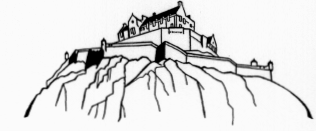
• were clustered around a castle or monastery where people could find work.
• were near a reliable source of fresh water.
• were established where there was good, firm dry land.
• were beside good farmland where farmers could grow enough food and supply enough raw materials for the people living in the burgh.
• were located near the sea, perhaps beside a natural harbour.
• were often located beside a ford or crossing point in a river.
• were at a crossroads or had important roads running through them.
• were small at first but grew very quickly.
The Burgh Charter
Not all villages or towns became a burgh:
this was a special privilege which was usually granted by a charter from the king or lord to the inhabitants.
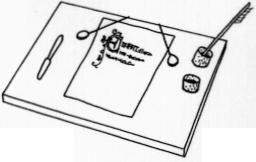
A charter was a legal document and was written on parchment by a monk or scribe in Latin. Often, at a later time, a king or queen would issue a further charter to confirm the original charter. In some burghs today, only later charters survive.
There were different types of burgh:
- granted by the king or queen. Many of the first royal burghs were created by King David 1(1124-1153) and may have been created by a declaration of the king rather than by a charter.• royal burghs
• burghs of barony
- granted by a lord.• abbatial burghs
- granted by the abbot of a monastery.• ecclesiastical burghs
- granted by a representative of the church.The people who lived in the burgh were called burgesses. Burgesses not only had certain rights but also reponsibilities.
Examples of rights Examples of responsibilities
• to have land in the burgh
• to obey the rules of the burgh• to trade in the town
• to help defend the burgh• fishing rights
• to help repair bridgesOnly burgesses who lived in royal burghs were officially allowed to trade abroad.

The Layout of Burghs
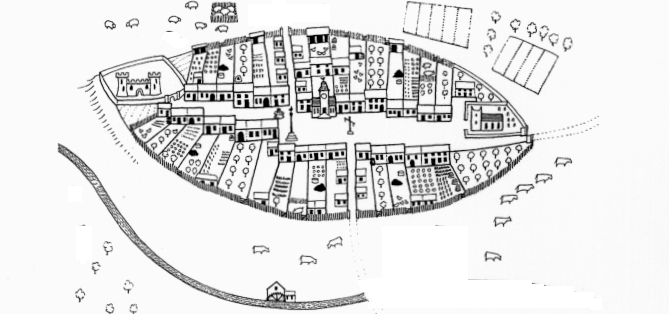
The layout of the burgh depended on the geography of the area. For example, ifa settlement had formed beside a castle or monastery on a hill, then streets would have to be built on, or round, the base of the hill.
Charters giving burgh status were usually granted to settlements which already existed. Once burgh status was granted, this led to the formal laying out of the burgh. In Scotland, a burgh usually consisted of one single street with a back lane running behind. Land was divided into long plots, known as burgage plots and these would run between the main street and the back lane, creating a ‘herring-bone’ pattern. This diagram shows a very basic layout.
9
The burgage plots were laid out by people called liners. These were burgh officers with responsibility for measuring burgage plots and supervising building matters. All plots would be the same width. Some burghs would copy each other and invite the same liners to lay out their burgh. For example, Mainard the Fleming who laid out Berwick was invited to lay out St Andrews, and Ranulf, who was also Flemish, laid out Haddington and Glasgow.
The Burgage Plots and the Backlands
The long narrow plots on which the houses stood were known as tofts or rigs as well as burgage plots. Houses were built on the part of the plot nearest the main street. In the area behind, known as the backlands, vegetables and fruit were grown for family use and also for sale. The well was in this area too, often next to the midden, where all the waste from the house went. Animals, such as pigs and hens, were kept on the backlands and craftsmen would have their workshops there too. There was also often an oven which was shared by two households next to each other. This oven was used to bake bread for the family, as baxters were the only people allowed to sell bread.
The plots usually ran to the boundary of the town, with gates out the back to the townlands, where there was often shared grazing ground for animals. In this way the fences at the ends of the plots formed the town boundary, with each burgess responsible for maintaining his own section.
The fences between the burgage plots and those creating the dyke or ‘heidroom’ at the bottom of the plot
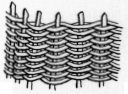
were made of wattle which was made up of twigs woven together. Later, wooden palisading and possibly a ditch, would protect the inhabitants of the burgh from unwelcome visitors. Some burghs had stone walls.
Tolls were collected at the ports or town gates, which were often closed atcurfew. The times of curfew were different in summer and winter and varied from burgh to burgh. If there was a danger that strangers might bring disease or plague into the burgh, the ports would not be opened to them.
As some burghs grew, the burgage plots started to get overcrowded and people even started to build in the market place. This changed the shape and layout of the original burgh. Also, in large towns, different market areas were created such as the Grassmarket or the Haymarket. Where space was very limited, some buildings grew up and out
- like Gladstone’s Land in the High Street of Edinburgh.

Houses in the Burgh
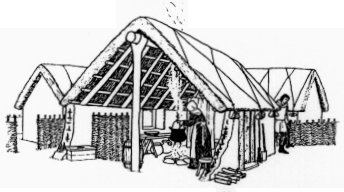
We must rely on archaeological evidence to find out about the houses which were built in early medieval burghs during the 12th century. This evidence shows that the houses were a single building with wattle walls and free-standing stakes to support the roof. There wattle
were no windows or chimneys and the doorway was protected by a leather cover. The floor was of gravel or earth, with a central fireplace consisting of a clay-lined hollow or slab. Smoke would find its own way out through the many gaps in the construction of the building. This building would be shared with the animals.
Gradually, houses became stronger. Daub, of either mud or dung, was pushed on to the wattle to provide some kind of windproofing and a wooden beam ran across the roof. People also started to use cobbles on the floors to replace the gravel. There is no evidence for the roofs of the early houses. These were most likely made of thatch of heather or straw. Later more important buildings had colourful pottery tiles on the roofs. There was a great risk of fire because it spread very quickly once it started.
During the 15th century, stone was used for some buildings but for very few houses. By the 16th century, some stone was used for houses but it was usually on the ground floor only. Some houses from this time had stone stairs outside at the front and some had slated roofs.
A reference, in 1317, to ‘the stone-house’ in Aberdeen tells us just how unusual stone houses were. We also know that as late as 1624 there were very few stone houses in burghs. In that year, the burgh of Dunfermline was almost completely destroyed in a fire because most of the houses were made of wood.
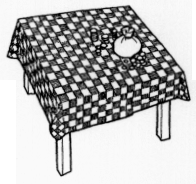

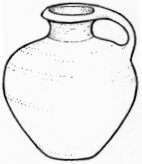
Furniture was simple. There was a table in every home which could be put up and down as needed. In merchant houses there may have been acompter which was a squared board put on top of the table and used for counting money. Checked table-cloths were also used for this purpose.
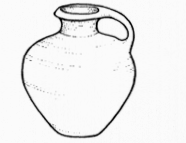
There were pottery pitchers, pewter or wooden plates
and knives and spoons but no forks.
There was possibly a linen cupboard and a cupboard for plates. Beds would be of a box-type. Straw was often used for bedding, although wealthier people may have had woollen blankets.
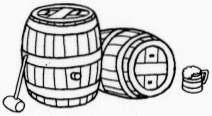
There would be at least one wooden barrel which contained the family supply of salted beef or possibly fish.
In the early Middle Ages, straw was used as a floor covering. This straw was often shared with the animals which were kept in the house. Wealthy people may have had rugs.
It is important not to jump to conclusions about living standards. There was a difference between the living standards of, for example, a merchant and a shoemaker but we do not have enough evidence to describe their lifestyles in detail.

The Parish Church
Medieval people were very religious. The parish church was one of the most important buildings in the burgh. Sometimes the church was built before any other buildings and the town only grew up afterwards. The church was an important meeting point and was used by everybody in the burgh.
The parish church was usually very well-cared for. Inside there were colourful statues and lovely decorated objects for use during the services. There would be more than one altar and merchant and craft guilds would pay for their own altars and make them very beautiful with candles and other expensive objects. The altar might be dedicated to their patron saint, or to the Holy Blood or Holy Rood.
After 1560, many medieval churches fell into ruins not just because of the damage caused by the Protestants during the Reformation but also because the Protestants built new churches to suit the different form of worship. All the statues and beautiful decorations were destroyed. Only a few of the medieval churches, which continued to be used after the Reformation, still survive.
Today there are usually several churches in each town belonging to different religious groups.
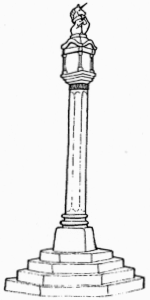
The Tolbooth
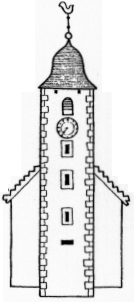
The tolbooth, which was later known as the town-house, usually overlooked the market-place in the centre of the burgh. The market cross, the tron, where weights were checked and stocks where people were punished, were often nearby. The tolbooth housed the burgh court, the jail and the council rooms~ The "jougs", an iron collar which was fastened round the neck of the person who was being punished, was often attached by a chain to the wall of the tolbooth or the parish church. There was no set pattern for the tolbooth but this drawing gives an idea of how this building might have looked. Some tolbooths still survive to this day, although they have changed a lot over time.
The Market (Mercat) Cross
This was the place where, by a law said to have been made by William 1(1165-1214), all goods to be sold in the burgh had to be presented.
The market cross was the central point in the market-place, where all announcements were made. The style of the cross varied from burgh to burgh. It often had steps and a stone pillar with a unicorn at the top. As burghs grew, there might be several markets for different types of goods.
Investigations
Is there any evidence to show where the tolbooth was in your town?
Is there a court building in your town? If so, where is it?
Is there any evidence to show where the market place in your town was?
Was there ever more than one market place in your town?
Where is the market cross today and where was it during the Middle Ages?
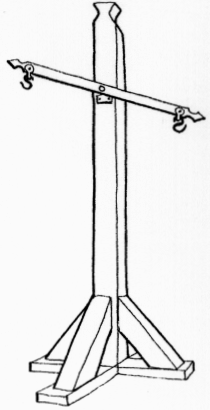
The tron was also known as the public weigh-beam and would be found near the tolbooth in the centre of the burgh. This was where goods for sale would be checked to make sure that they were the right weight and that no-one was cheating. The standard measures of the burgh were used and these were sealed with the burgh seal. It was the burgh’s responsibility to check that the weights were accurate and to ensure that the burgh seal was kept in tact.
The tron was usually made of wood so there are no
original trons left today.
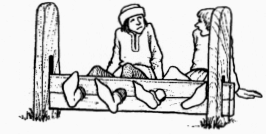
The Stocks The market cross was often the place where people were punished. For example, the stocks were usually here, in full view of everyone. The length of time a person spent in the stocks depended on the rules which they had broken. The worst punishment, however, was to be
banned from the burgh.
Investigations
Where was the tron in your town?
What did the burgh seal of your town look like?
What are the most common weights and measures used today? What different weights and measures have been used in the past?
Does your local museum have the old town weights?
Merchants
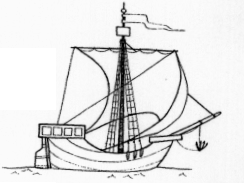
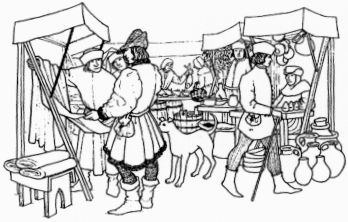
Merchants were involved in the trading activities of the burghs. However, officially, only merchants in royal burghs had the right to trade overseas. Merchants in royal burghs could become very rich and they often had shares in ships used for trading overseas.
Many merchants had shops or booths where they would sell the goods they imported. These might include luxury goods such as silks and fine fabrics, wines, jewellery and a wide range of spices which were used to flavour food. The burgh charter granted the right to hold markets and would state the number of markets which could be held in the year. Markets were often held weekly. People from outside the burgh who wanted to sell goods at the market had to pay customs tolls.
The burgh council controlled the market regulations. For example, they stated when the market could start and finish selling. Merchants were often members of the burgh council and in this way held control over the trading affairs of the burgh.
The burgh council controlled the prices and the quality of goods sold in the burgh. It was an offence to forestall, that is, to buy goods before they reached market to avoid paying any extra charges. Regrating was also an offence. This was when goods were bought up to create a shortage, in order to push up the price.

Local produce such as cheese, eggs, butter and flour were sold at burgh markets as well as goods from further afield. We know that there was a lot of trade with England during the Middle Ages and that during the reign of Alexander III (1249-1286) nine-tenths of the coin in circulation in Scotland was English. Unfortunately we do not have many statistics to tell us more about this overland trade with England.
During the Middle Ages, much of Scotland’s trade consisted of cloth, wool, woolfells (sheep’s fleeces with the skin attached), hides, skins and salmon. From the 153 Os, herring were exported in increasing numbers and there was a boom in the trade of salt and coal from the towns on the Forth estuary during the 16th century. Luxury goods were imported. These would include fine cloth, silks, jewellery and spices.
There were three main overseas trading patterns:
• Trade with the Eastern Baltic at Stralsund and Danzig (present day Gdansk). This did not include Sweden until the 17th century. Most of this trade consisted of hides or small mixed packs of wares which included coarse cloth. There are no substantial early records.
• Trade with the Netherlands through Flanders and the staple (trading centre) of Bruges with its port of Sluis. The main export until at least 1400 was wool. By the 1470s the staple port had moved to Middelburgh. This port was used until about 1505 and then Veere (Campvere) on the island of Walcheren was used where there was a Scottish colony. Until the seventeenth century, Scottish goods were shipped here and taken further inland.
Trade with ports in the north of France, especially Dieppe. Wool, cloth and skins and other commodities were exported and by 1500 the export of salmon was increasing. There was a well-established wine trade through the port of Bordeaux by the 15th century.
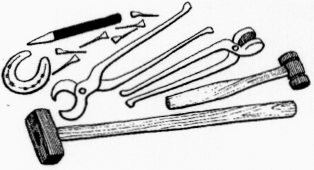
The craftsmen found in each burgh might include weavers, tailors, shoemakers, cordiners (leather-workers), fleshers, hammermen, (which included all metal-workers such as blacksmiths, pewterers, locksmiths, cutlers, shearsmiths, armourers and lorimers who made the metal parts for horse harnesses and carried out small metalwork), saddlers, brewers, baxters and coopers. Coopers were in great demand because many barrels were needed to store salted beef and fish. There would be different craftsmen in the burgh depending on what was needed. For example, there were many wigmakers in Edinburgh.
By the 16th century, craftsmen had their own incorporations or guilds which had their own rules and regulations. Some rules were drawn up to make sure that their work was of a high standard. No-one could join the guild unless he had first been an apprentice. Apprentices were closely supervised and their training would last between five and seven years. Before an apprentice was allowed to be a member of the guild, he had to submit a piece of work as a test of his skill.
The guilds raised funds to maintain their altars in the parish church and to provide for the care of the widows and orphans of members. The guild also controlled the wages and prices of its members and could discipline members.
The burgh council was responsible for seeing that the quality of the goods sold was of the right standard. For example, ale-tasters were employed to test the quality of the ale for sale and baxters could be fined if the bread they sold did not reach a certain weight or quality.
Investigations
What different kinds of craftsmen were in your town during the Middle Ages?
Who is responsible for the quality of goods which are sold today?
Is there any evidence for guilds at the parish church or in the graveyard?
From evidence found in the middens, we can find out about the diet of the people. Blackberries, blaeberries and raspberries were eaten and vegetables were grown in the burgage plots. Oatmeal was a very important part of
the diet and bread was baked in the oven in the backlands. If food was in short supply, people were not allowed to sell it outside the burgh.
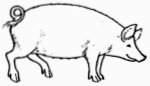
Shells of cockles, mussels and winkles have been found. There is also evidence for chickens, geese and wild birds in the people’s diet. Bones and parts of skeletons show that large animals including cattle, sheep, goats and deer were butchered. Every part of the animal was used.
Most animals which were still alive at the the beginning of winter were killed and the meat was salted to preserve it. This meant that there was a great demand for salt and spices to preserve and flavour meat. A few of the best animals were probably kept over the winter to provide breeding stock for the next year.
Water Supply
The water supply was often polluted. The household supply was often too near the midden where rubbish was dumped and the water in the wells which were used by everyone in the burgh were also often polluted. Water from the river was used by animals and industries such as the tanning industry. Because much of the water supply was polluted, people tended to drink ale. This was sold by the pint or gallon.
Animals were slaughtered and butchered in the street and fish were also gutted in the street. Later there were attempts to have official middens and street-cleaners.
The midden, where all the waste from the house went, was often next to the well in the backlands and the water supply was easily polluted. Rats and fleas were a common problem.
There were many diseases such as measles, scarlet fever, pneumonia and cholera and examination of skeletons has shown that there was also tuberculosis, spina bifida and arthritis. Tooth decay was common.
Leprosy was also greatly feared since it could easily spread from one person to another. A leper house was situated outside the town. People with skin disorders were often sent to the leper house since people were so frightened by the disease.
Many illnesses were called plague and there were many types of plague.
Pneumonic plague was probably more common in Scotland than bubonic plague.
Pneumonic plague, which survives well in damp conditions, passed from one
person to another through the air and was very infectious, leading to a quick death.
Many children died before they grew up and most adults died between the ages of 40 and 50. Many women died giving birth.
Average height
Archaeologists looking at skeletons from excavations in Aberdeen suggest that the average height for medieval men was about 165 cm and 157 cm for medieval women. Today it is about 178 cm for men and 165 cm for women.
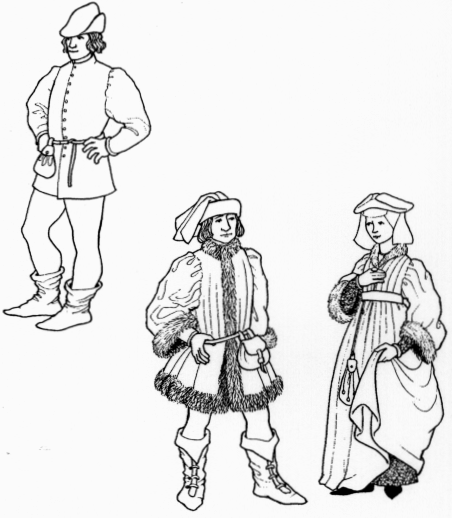
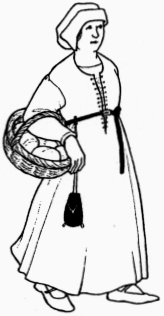
Clothes
Clothes worn by people during the Middle Ages were mostly made of wool or coarse linen. Flax which was grown in the backlands or imported from Flanders, was spun and woven in people’s homes. Only the wealthy would have been able to afford to buy silks and velvets imported from abroad.
Textiles do not survive well, so there is little archaelogical evidence of the clothes worn. Some leather from shoes and jackets has survived and many buckles and brooches have also survived.
Looking for Evidence
Historians and archaeologists use many different sources to build up a picture of life in the past. In the Burgh Survey for your town you will find many different examples of archaeological and historical evidence.
Sometimes very old documents survive such as the burgh charter or lists of goods which have been traded. Old maps might show how streets and buildings looked hundreds of years ago and drawings such as those done by John Slezer during the 17th century help us to picture how towns looked in the past. Photographs are a useful source not only for the past lOO years but also for earlier times since many towns remained almost the same from medieval times until the 19th or 20th century.
Archaeologists build up a picture of life in the past from the mass of evidence that people have left behind often in rubbish heaps. Some examples might be broken pottery, pieces of metalwork and nails, the waste left from eating meat and bone combs. If the ground is waterlogged, bits of leather shoes, wooden plates and barrels, the bottoms of wattle buildings or wooden trackways might survive. The level under the ground helps archaeologists to identify whether the artefacts found are medieval or from an earlier or later date. The diagram on the following page shows how this is done. All this evidence must be carefully examined.
Buildings are also a useful guide to what your town was like in the past. Some buildings may provide evidence from different times while others may not have changed very much at all.
Most local libraries have a folder of information with different types of sources. There will also be books written about the history of the town. Some of these might even be primary sources such as a diary written by someone who visited your town on travels around Scotland. Local museums often have examples of artefacts which have been found in or near the town during archaeological excavations.